
World first in the development of high-capacity sorption cryocoolers
To enable highly accurate, disturbance-free measurements at extremely low temperatures, the Einstein Telescope (ET) requires vibration-free cooling. The consortium consortium Zero-Vibration Sorption Cryocooler for the Einstein Telescope, consisting of Demcon kryoz, the University of Twente and Cooll, is developing a solution based on sorption cooling, a principle already used in cryogenic microcoolers. The partners are now scaling this technology up to the macro level, something that has never been achieved for cryogenic applications. With this development, the consortium is creating a unique value proposition in vibration-free cryocooler technology. consortium aan een unieke propositie voor trillingsvrije cryocoolertechnologie.
The consortium is the first to develop a high-capacity cooler (also known as a sorption-based Joule-Thomson cooler) that operates vibration-free within a fully closed system while remaining compatible with the ultra-high vacuum (UHV) environment required by the Einstein Telescope. This represents a world-first in cryocooler technology for extremely low temperatures. By connecting all subsystems through carefully engineered interfaces, the consortium has developed a reliable solution to one of the key cooling challenges facing the Einstein Telescope. It marks an important breakthrough for cooling the ultra-sensitive scientific instruments of the future.
Vibration-free cooling for the Einstein Telescope
The Einstein Telescope will detect gravitational waves generated by enormous cosmic events deep in the early universe. After travelling astronomical distances, these waves reach Earth as extremely small ripples in spacetime. Detecting them is only possible at ultra-low temperatures and in an environment of complete mechanical silence. Conventional cooling systems disturb this silence; much like the compressor of a household refrigerator, they generate vibrations. Eliminating these vibrations is therefore one of the major challenges for the consortium, which is developing a sorption cooling solution together with research partner the University of Twente and ETpathfinder.
ETpathfinder is the Einstein Telescope laboratory at Maastricht University, initiated by Nikhef, where the technology is validated and integrated for future applications in the Einstein Telescope.
Read the interview with Adrie Visser, Project Manager, and Romaine Kunst, Thermal System Engineer at Demcon Kryoz, as well as Albert van Dorssen, Business Developer for Valorization at the Einstein Telescope Project.
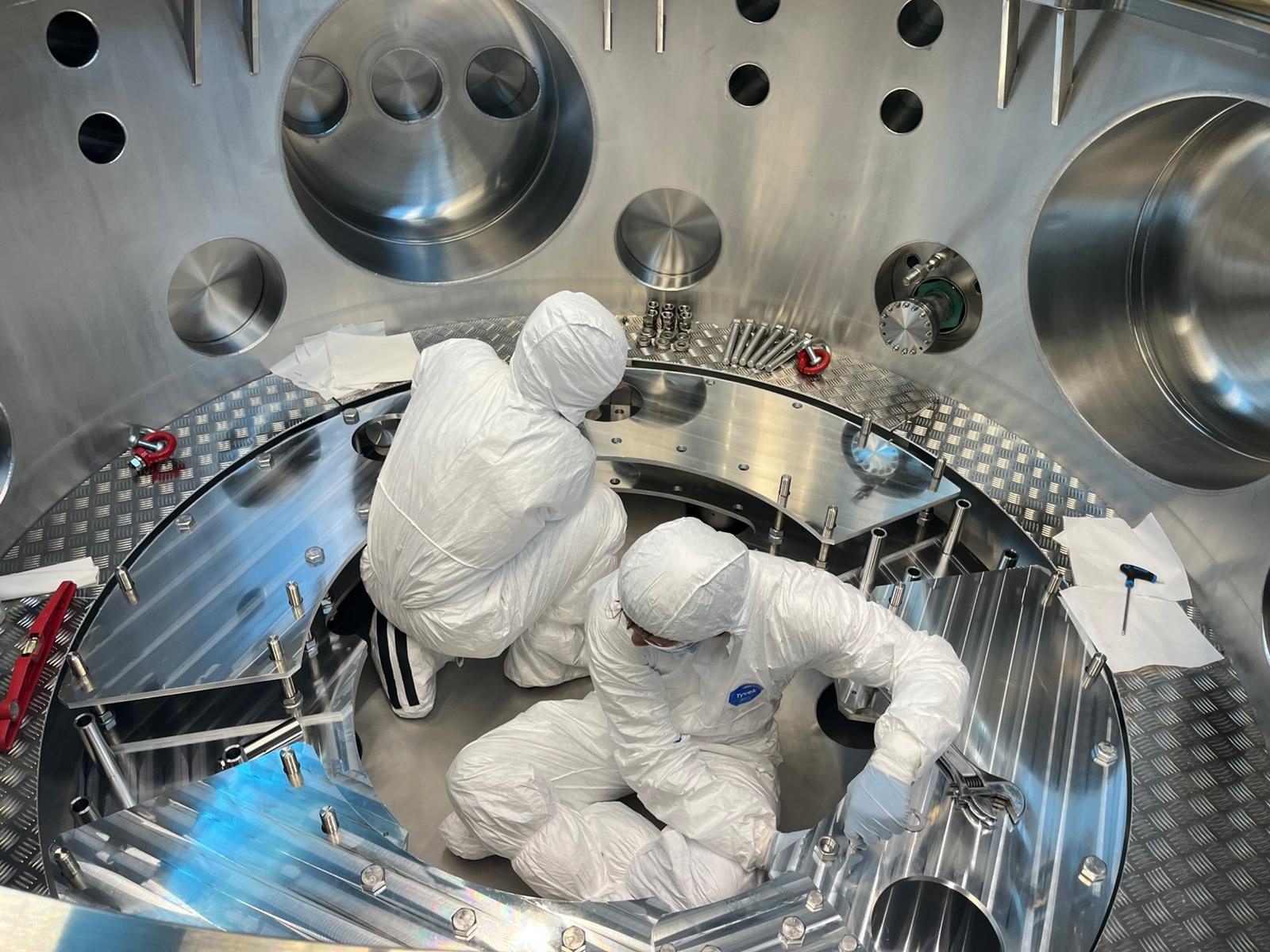
Scaling sorption cooling from micro to macro
Cooling is a cyclic process in which a refrigerant gas absorbs heat from the component to be cooled and releases it elsewhere. To maintain this cooling cycle in a closed system, the gas must be compressed. Conventional compressors rely on moving mechanical parts driven by electric motors, inevitably producing vibrations that are unacceptable for the Einstein Telescope.
Sorption cooling works differently. It uses the adsorption and desorption of gas by activated carbon. During the compression phase, the adsorbed gas is released by heating the activated carbon, allowing pressure to build up for the cooling process. Because this compression is driven entirely by heat rather than moving components, the process is vibration-free.
The University of Twente has been conducting research into sorption cooling since 1995, resulting in several successful spin-offs. One of these is Demcon kryoz, which develops cryogenic Joule-Thomson microcoolers for applications ranging from microscopes to communication satellites. Through this expertise, the company became involved in the Einstein Telescope project and now leads the Zero-Vibration Sorption Cryocooler consortium.
Challenging requirements drive technological upgrades with broad impact
"At Demcon, we are used to carrying out R&D for customers who approach us with highly complex engineering challenges," says project manager Adrie Visser. "That is exactly what motivates us. In a big-science project like the Einstein Telescope, those challenges become even greater. The vibration and temperature requirements are extraordinarily demanding and operate at the highest scientific level. Working on them pushes us to continuously improve our capabilities."
"One concrete example is the LEM toolboxes we use in our projects. LEM (Lumped Element Modelling) is one of Demcon kryoz's core specialisms for analysing complex installations. The models, originally developed at the University of Twente since 1995, had to meet unprecedented requirements for ET. This led us to significantly expand our modelling capabilities. Today, we can dynamically simulate an entire cooling system within a single model."
 Adrie Visser
Ready for integration into laboratory environments
The consortium has made substantial progress in scaling up the sorption cooling technology, explains Romaine Kunst, Thermal System Engineer at Demcon kryoz.
"Our first milestone was the conceptual design report, which was very well received by ETpathfinder last year."
"During this preliminary phase we applied an extensive systems engineering approach. This enabled us to provide our partners with comprehensive information, including detailed risk analyses and studies on how our system interacts with the other ET systems. We have now almost reached the milestone of being ready for integration."
Meanwhile, work is progressing rapidly on the most important component of the cooling system: the sorption compressor.
Visser explains; "Currently, the University of Twente, Demcon and Nikhef are assembling the first systems together. This summer we expect to integrate the first complete system into the High Pressure Laboratory at the University of Twente. If the results are positive, we will simultaneously continue work in the cleanroom facilities in Maastricht. By the end of this year, we expect to have the first complete system ready for ETpathfinder."
 Romaine Kunst
Testing in Twente, integration in Maastricht
The first sorption cooler will be assembled and tested in Twente. "In Maastricht, everything is housed in a cleanroom because ET will ultimately operate under ultra-high vacuum conditions. At the University of Twente, the environmental requirements are less restrictive, giving us greater flexibility to experiment in the laboratory”, Kunst explains.
"Using additional sensors, we will validate the vibration performance. The key question is whether our cryocooler remains below the background noise level measured in Maastricht, which is 32 nanometres peak-to-peak. Once the measurements in Twente have been successfully completed, integration into the ET test setup in Maastricht can begin."
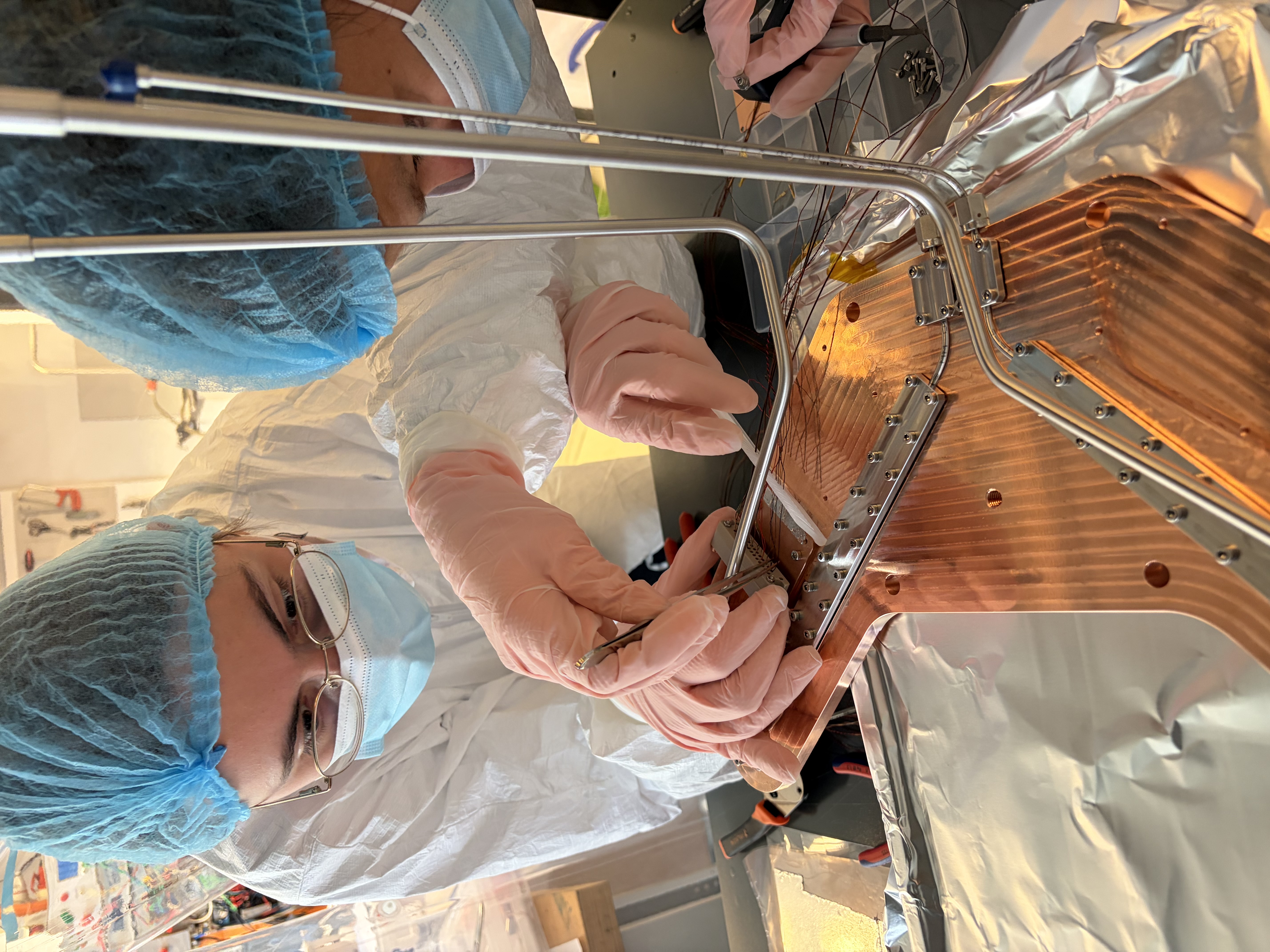 Work on the heat exchanger of the sorption chiller
Partners contributing carbon technology, cooling expertise and scientific knowledge
The smooth progress of the project is largely due to the close collaboration between the consortium partners. Earlier this year, Cooll, another spin-off from the University of Twente, supplied the sorption compressor cells filled with activated carbon pellets for gas adsorption.
"They are the only company in the world capable of producing these carbon pellets with such a large internal surface area, making them exceptionally efficient," says Kunst. "For the Einstein Telescope they invested significant effort in optimising the design and performing lifetime tests to ensure the pellets will remain operational for at least ten years. This intensive R&D programme has generated valuable knowledge that can also benefit many other applications."
Within the Einstein Telescope, the sorption coolers form part of an efficient three-stage cooling process that starts at liquid nitrogen temperature. A dedicated pre-cooling "kickstarter" system prepares the process before the sorption cooler takes over. Stirling Cryogenics supplied specialised CryoFan cryogenic pumps for this purpose, while Demaco installed the complete liquid nitrogen infrastructure at the University of Twente and Maastricht University.
Additional specialist expertise was contributed by partners such as ASTRON, the Netherlands Institute for Radio Astronomy, including knowledge on high-performance black heat-absorbing coatings.
“Ultimately, this project has advanced the Dutch cryogenic network not only technically, but also in terms of content and collaboration,” said Romaine Kunst.
Strengthening the Dutch cryogenic ecosystem
According to Visser, suppliers throughout the Netherlands have become inspired by this pioneering project.
"For example, we were searching for components that were both ultra-high-vacuum compatible and cryogenically compatible. That combination is quite unique, so we engaged with several suppliers. One supplier was unsure whether its UHV components could also operate under cryogenic conditions. We connected them with the University of Twente to test them."
Kunst adds: "Our heater supplier initially recommended a lower power level than we required. We therefore performed our own calculations to demonstrate that higher power levels could safely be used. Particularly during the detailed design phase, finding suppliers capable of meeting all technical requirements proved challenging. Ultimately, this project has strengthened the Dutch cryogenic ecosystem—not only technically, but also in terms of collaboration and shared expertise."
Systems engineering as a key success factor
Nikhef is one of the project's most important partners, Kunst continues. "They are the end user of our system and, together with Maastricht University, lead the ETpathfinder laboratory. Our system interfaces with 21 other systems within the laboratory, requiring intensive coordination to ensure everything functions seamlessly."
Albert van Dorssen, Business Developer within the Einstein Telescope Valorisation Team, sees systems engineering as a crucial success factor. "From the very beginning, Demcon kryoz has applied a highly structured approach to defining and validating all requirements and interfaces. That expertise enables the smooth development of highly research-intensive systems that eventually evolve into industrial solutions."
Kunst explains; "At the start of the project, I prepared a Customer Requirements Document for Nikhef summarising all 21 interfaces. This ensured they were visible from day one, allowing us to continuously refer back to them throughout the project and preventing them from becoming critical issues later."
According to Visser, this explains why Demcon kryoz - despite being a relatively small company supported by parent company Demcon - can successfully coordinate a consortium involving organisations such as Nikhef and the University of Twente.
"This works because every partner contributes its own strengths. Nikhef has specialised laboratory facilities and expertise in areas where we are relatively new, and the same applies to the University of Twente. Our role is to maintain the overall system perspective, ensure that all interfaces fit together both functionally and physically, and coordinate effective collaboration across the consortium."
“An interesting aspect regarding the design dimensions is the compactness of sorption chillers. This is playing an increasingly important role in these sectors, as there is growing demand for more robust and smaller chillers,” says Albert van Dorssen.
Looking beyond the Einstein Telescope
According to Kunst, the project has resulted in a truly unique cooling system. "This technology represents a major improvement over existing cooling methods." The same technology could also prove valuable for telescopes that currently rely on mechanically driven compressors to cool optical systems, limiting image resolution. "Personally, I dream of further developing this technology. Space and astronomy are obvious application areas, but there are many other research environments where higher resolution would make a real difference; for example medical imaging of cryogenically cooled samples or scientific microscopy."
"The vibration requirements are equally important for quantum computers, operating at even lower temperatures. Another advantage is that our system is completely closed, whereas many existing cooling systems still rely on externally supplied liquid nitrogen." Van Dorssen highlights another important advantage: "The compact size of sorption coolers is becoming increasingly important. Across these sectors there is growing demand for cooling systems that are smaller, more robust and easier to integrate."
Visser confirms that interest is growing rapidly. "Many organisations are following our work on the Einstein Telescope with great interest. Not only Demcon kryoz, but many others are already thinking about future applications."
Valorisation of unique sorption cooling technology
This groundbreaking sorption cooling technology offers significant opportunities for valorisation across a wide range of future scientific and industrial applications.
The consortium welcomes discussions with organisations interested in exploring these opportunities. Interested parties are invited to contact Albert van Dorssen, Business Developer within the Einstein Telescope Valorisation Team