
Dutch sensor technology pushes the boundaries for the Einstein Telescope
The Einstein Telescope, a major big-science project, uses ultra-precise mirrors to push the boundaries of gravitational-wave detection. To enable measurements of such extraordinary precision, these mirrors need to be shielded from environmental vibrations as effectively as possible and therefore kept virtually ‘vibration-free’. Extremely sensitive sensors are needed to achieve this. This is what the SENVIDET consortium (Sensor Engineering for Noise and Vibration Isolation and Damping in Einstein Telescope) is working on, with a particular focus on low-frequency vibrations.
Three SMEs – Somni Solutions, Innoseis Sensor Technologies and Quantified Air – are developing the sensors, while three major partners – Nikhef, Demcon HTS and VSL – provide support in systems engineering and validation. The project is partly funded by the Dutch National Growth Fund. Several important milestones have already been reached. Somni Solutions, for example, has demonstrated that its first sensor prototype works. Nikhef has also recently commissioned its ‘OmniSens 6D’ seismic isolation setup for testing sensors. Meanwhile, sensor development continues, and the newly developed sensors are undergoing further testing in high vacuum.
These milestones are important steps towards achieving a ‘vibration-free’ environment, one of the crucial requirements for the Einstein Telescope’s (ET) detection principle. This principle is based on interferometry: the interaction between laser beams travelling back and forth between mirrors from different directions. To achieve the extremely high precision required, these mirrors need to remain virtually motionless. In practice, however, they move and vibrate as a result of all kinds of disturbances, ranging from human and seismic activity to thermal and quantum noise.
In a sophisticated multi-stage suspension system that isolates the mirrors from ground vibrations, the mirrors must be actively kept in position. This is only possible if even the smallest displacement can be measured with an accuracy of up to a billionth of a metre or a billionth of a degree of angular displacement. Suitable sensors already exist for fast, high-frequency vibrations, but not yet for low-frequency vibrations. These are essential because ET will not only observe gravitational waves at higher frequencies, as previous generations of detectors have done for many years, but also at low frequencies. In the 1–10 Hz range, scientists will be able to ‘see’ even more cosmological processes and heavier astronomical objects.
Three sensor SMEs, three large partners
SENVIDET’s challenge is to combine low-frequency measurements with extremely high sensitivity, explains Hedde van Hoorn, Senior Project Lead at Somni Solutions and consortium coordinator. “We now really want to measure below 3 Hz, and that requires new sensors.”
Within the SENVIDET project, improved optical sensors are being developed based on fibre-optic technology and interferometry – an advanced and versatile measurement technique used not only by ET as a whole, but also by individual components within ET. The research focuses on reducing sensor noise at low frequencies.
Three SMEs – Innoseis Sensor Technologies, Quantified Air and Somni Solutions – are developing the sensors, while three large partners provide support. The project focuses on sensors for rotation (Innoseis) and translation (Somni), while Quantified Air is working on a new interferometric technique for reading out the rotational sensors. Demcon HTS Delft leads the systems engineering: positioning the sensors correctly and integrating them into the control system that keeps the mirrors motionless. As the Dutch national metrology institute, VSL is working on developing the necessary calibration methods, which presents a major challenge in itself. Nikhef acts as the central hub, providing the knowledge and overview of what is required for ET. Nikhef is now using its new OmniSens 6D setup for validation: demonstrating that the sensors perform as intended.
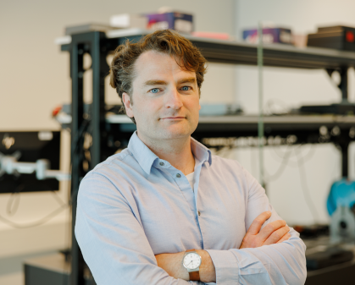
Photo Hedde van Hoorn (Somni Solutions): “I am proud that, as relatively small players, we are able to carry out fundamental development in-house. What is happening here in the Netherlands is truly state of the art.”
Sensor with an extremely low noise level
Somni is developing an inertial sensor: an accelerometer that measures displacement in two directions simultaneously. The sensor uses fibre optics exclusively, meaning that no electronics are required inside ET. Ultimately, it must be capable of measuring extremely small vibrations, resulting in highly demanding specifications.
For this reason, Somni is developing the sensor step by step, Van Hoorn explains. “We have now statically calibrated the first version at VSL, demonstrating that the sensor works and has very high sensitivity. That was quite exciting; once everything is connected, you still have to wait and see whether the sensor produces the readout you expect. We then tested its dynamic response at Nikhef. Compared with a seismometer, it performs very well. That is encouraging and allows us to take the next step towards an even lower noise level. To achieve this, we need to develop a new way of reading out the sensor, because in the current version the limitation lies in the sensor readout rather than in the sensor itself. We need to move beyond that limit to meet ET’s specifications.”
Dutch sensor technology at the state of the art
The three sensor companies are pushing the boundaries of current technology with their developments. For testing, they deliver their sensor systems to Nikhef. The research institute recently commissioned a high-vacuum test setup in Amsterdam.
According to Albert van Dorssen, Business Developer within the Einstein Telescope Valorisation team, the initial results are promising. “Nikhef is very positive about the developments within SENVIDET.”
According to Van Dorssen, sensor technology with the required level of precision was not commercially available. “Nikhef searched worldwide and tested various commercially available systems. The Dutch partners within SENVIDET are now developing technology that has the potential to meet the requirements. This is technically extremely challenging. Although each company is working on its own solution, you can see that they inspire one another in the process. They contribute not only their knowledge of sensor technology, but also their experience in industrialising it: taking the step from technological development to a product that can actually be manufactured.”
Van Hoorn recognises this interaction. “I am proud that, as relatively small companies, we are able to carry out this fundamental development ourselves. What is happening here in the Netherlands really is state of the art. At the same time, we learn a great deal from one another. Developing these sensors involves many technical challenges. By discussing them together, we help each other move forward.”
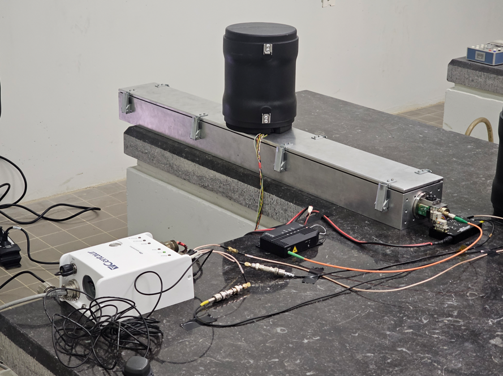
Photo: setup with the Innoseis sensor in the Heimansgroeve, a suitable environment for testing for the sake of ET.
Opportunities from quantum technology to nuclear fusion
Vibration isolation plays an important role in many advanced applications. Van Dorssen therefore sees opportunities for the sensor technology being developed within SENVIDET beyond the Einstein Telescope, including in the semiconductor industry and the emerging field of quantum technology. “Somni’s CEO has indicated that the company is very keen to participate in this project. By taking a modular approach to sensor technology, individual elements of the development can also be incorporated into products for other markets.”
Van Hoorn also sees a range of potential applications. “An important advantage of our optical sensor technology is that it does not pose the same explosion risk that electrical sensors can, while it is also less susceptible to wear.”
He also identifies nuclear fusion as a potential application area. “Our technology is suitable for extreme conditions, such as the high temperatures and radiation levels associated with nuclear fusion. In addition, we can map seismic vibrations with very high precision, for example for earthquake monitoring.”
The Einstein Telescope itself also offers significant potential. If realised, the observatory will require several hundred mirror towers, each containing multiple sensors. However, Van Hoorn primarily sees the Einstein Telescope as an important environment for developing and demonstrating new technology. Funding from the Dutch National Growth Fund helps make these technological developments possible and enables the associated development risks to be shared. “Within this project, we can develop new technology for which we would not have the budget independently and for which we could not bear the development risk on our own. We hope this will ultimately lead to a sensor that we can also manufacture and sell on a larger scale for other applications.”
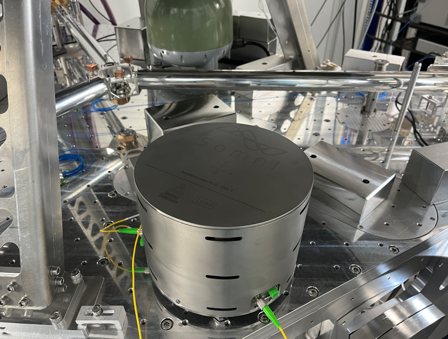
Photo: the Somni sensor during a test at Nikhef.
Valorisation of unique sensor technology
This boundary-pushing sensor technology therefore offers numerous opportunities for valorisation in new scientific and industrial applications. The consortium members welcome contact with interested parties. For more information, please contact Albert van Dorssen at albert.van.dorssen@liof.nl or Hedde van Hoorn at hedde.vanhoorn@somnisolutions.com.